AI Governance in Higher Education: Why Laws, Regulations, and Standards Matter
As colleges and universities adopt AI to streamline hiring and workforce management, new risks emerge alongside the promise of efficiency. Algorithms now influence job postings, candidate screening, performance evaluations, student employment, and even health record analysis.
But without clear governance, these tools can reinforce bias, violate rights, or erode trust.
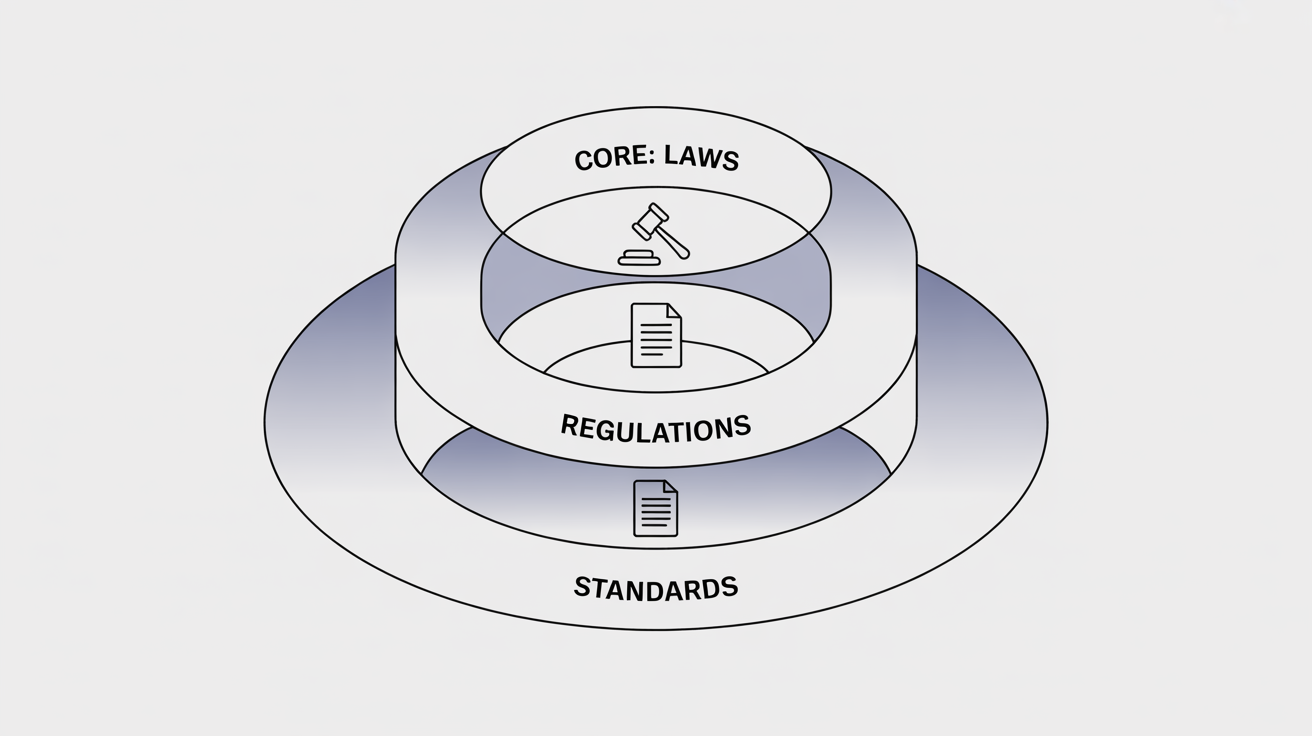
To ensure ethical, compliant, and human-centered AI across higher education, institutions must anchor their practices in three essential pillars: Laws, Regulations, and Standards.
⚖️ 1. Laws: The Non-Negotiables
Laws define the baseline. They protect individuals from harm and hold institutions accountable. For higher ed, key legal mandates include:
Title VII of the Civil Rights Act (U.S.) Prohibits discrimination in hiring based on race, sex, religion, etc.AI-driven hiring tools must avoid encoding or amplifying bias in faculty selection.
Americans with Disabilities Act (ADA) Requires accessibility in hiring practices.Automated screening tools must accommodate candidates with disabilities.
Family Educational Rights and Privacy Act (FERPA) Protects student education records.AI systems that analyze or access student data (e.g., predictive analytics for advising) must safeguard privacy and limit disclosure.
Health Insurance Portability and Accountability Act (HIPAA) Governs confidentiality of health data.AI used in student health services or counseling centers must comply with medical data protection standards.
General Data Protection Regulation (GDPR) Governs personal data use in EU-related contexts.Universities must ensure consent, transparency, and data minimization when processing student or employee data.
EU Artificial Intelligence Act (2024)Classifies hiring and biometric AI as “high-risk.”Requires human oversight, documentation, and bias mitigation.
Equal Employment Opportunity (EEO) Laws Ensure equitable access to employment.AI used in hiring or promotion must avoid disparate impact on protected groups.
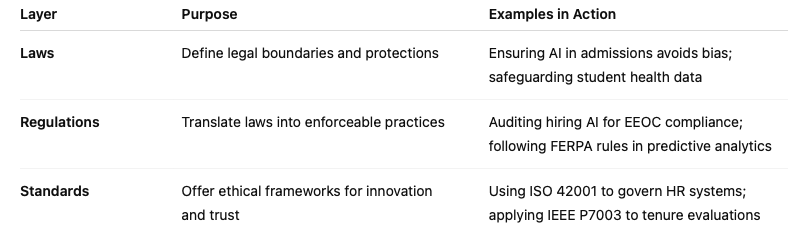
Why it matters:Noncompliance can lead to lawsuits, penalties, and erosion of public trust. An AI tool that unintentionally filters out first-generation students from targeted academic support could raise FERPA and equity concerns.
📜 2. Regulations: The Operational Playbook
Regulations offer clarity on how to comply with the law. Relevant guidance includes:
Equal Employment Opportunity Commission (EEOC) Guidance Advises employers to audit AI tools to avoid discriminatory outcomes.Applicable to hiring, evaluation, and automated decision-making.
Department of Labor (DOL) Rules Enforce fair labor practices.AI tools used to schedule student workers must comply with wage and hour laws.
Office of Federal Contract Compliance Programs (OFCCP) Applies to federally funded institutions.Mandates non-discriminatory hiring, including validation of AI tools.
Department of Education FERPA Regulations Detail how AI systems must handle student record access, use, and disclosure.
HIPAA Enforcement Guidance Regulates use of AI in health care and counseling, especially around data privacy and security.
European Data Protection Authorities (EDPAs) Guidelines Provide implementation details for GDPR compliance in AI.
Why it matters: Regulations translate legal principles into technical and procedural safeguards—like requiring explainability in student success algorithms or audit trails in AI-powered hiring platforms.
📐 3. Standards: The Blueprint for Leadership
Standards aren’t mandatory—but they define excellence. They help institutions go beyond compliance toward trustworthy, responsible innovation.
Examples include:
ISO/IEC 42001 (AI Management System Standard) Provides a governance structure for responsible AI use in education, HR, and medical contexts.
IEEE P7003 (Algorithmic Bias Considerations) Framework to identify and reduce bias in algorithms—essential for faculty search tools or automated performance evaluations.
NIST AI Risk Management Framework (AI RMF) U.S. voluntary guidance for identifying, managing, and governing AI risks across contexts, from student advising to medical triage.
SHRM AI Ethics Guidelines Offer HR-specific recommendations for transparent and ethical AI deployment.
Why it matters: Standards help institutions anticipate challenges, align with best practices, and support safe AI integration across research, teaching, student services, and administration.
🔍 Takeaway for Higher Ed Leaders
To govern AI responsibly, institutions must operate across three interconnected layers:
🧭 Final Thought
AI governance in higher education is not just about hiring—it's about stewarding trust across every domain where AI touches people’s lives: employment, student data, health care, and decision-making.
Institutions must move beyond point solutions toward systemic alignment with laws, regulatory frameworks, and forward-thinking standards.
Start with compliance. Scale with integrity. Lead with vision.
Learn more about responsible AI in higher education at Campus AI Exchange.Let’s shape an AI future worthy of our educational mission.
Sharing & Attribution
Created by Joe Sabado
Licensed under Creative Commons Attribution-NonCommercial-ShareAlike 4.0 International (CC BY-NC-SA 4.0)
You are free to share and adapt this work for non-commercial purposes, as long as you credit the original creator and share your adaptations under the same license.